How to Choose the Right Steel Grade for Your Project
Buying structural steel is not simply a matter of ordering a specific size, thickness, or profile. To select the right material, it is also important to consider the steel grade, its mechanical properties, chemical composition, and the role it will play within the project.
In the market, it is common to find designations such as A36, A529 Gr 50, A572 Gr 50, A709 Gr 50, A992, A913 Gr 65/70, A500, and A53. These correspond to ASTM specifications that help define the characteristics the steel must meet according to its intended use.
Understanding these differences makes it possible to purchase materials more accurately, avoid incorrect orders, and ensure that the steel complies with the requirements specified by the project’s engineering team.
“`Buying steel is not just ordering a size
One of the most common mistakes when requesting steel is focusing only on the material’s dimensions: the depth of a beam, the thickness of a plate, the diameter of a pipe, or the size of an HSS section.
- In practice, a proper purchase should consider three elements:
- Product: plate, standard steel shape, W/IPR shape, HSS, or round pipe.
- Grade: A36, A529 Gr 50, A572 Gr 50, A709 Gr 50, A992, A913 Gr 65/70, A500, and A53.
- Application: general use, main structure, connections, bridges, columns, frames, diagonals, fluid conveyance, or general fabrication.
When these three elements are clearly defined, it becomes easier to select the right material and confirm that it meets the requirements specified by the project’s engineering team.

What an ASTM Specification Defines
ASTM specifications help standardize the requirements that steel must meet, including its mechanical properties, chemical composition, and, in some cases, additional conditions depending on the type of material or application.
This makes it possible to distinguish between materials that may look the same at first glance, but are not necessarily the same from a technical standpoint. For example, two steels may share a similar reference strength, such as Gr 50, but fall under different specifications and be intended for different uses.
That is why it is important to review the full specification, the product type, and the project requirements.
Basic Concepts: Fy, Fu, and Gr
When talking about steel grades, it is common to come across terms such as Fy, Fu, and Gr. These help identify the material’s mechanical properties or specific designations within an ASTM specification.
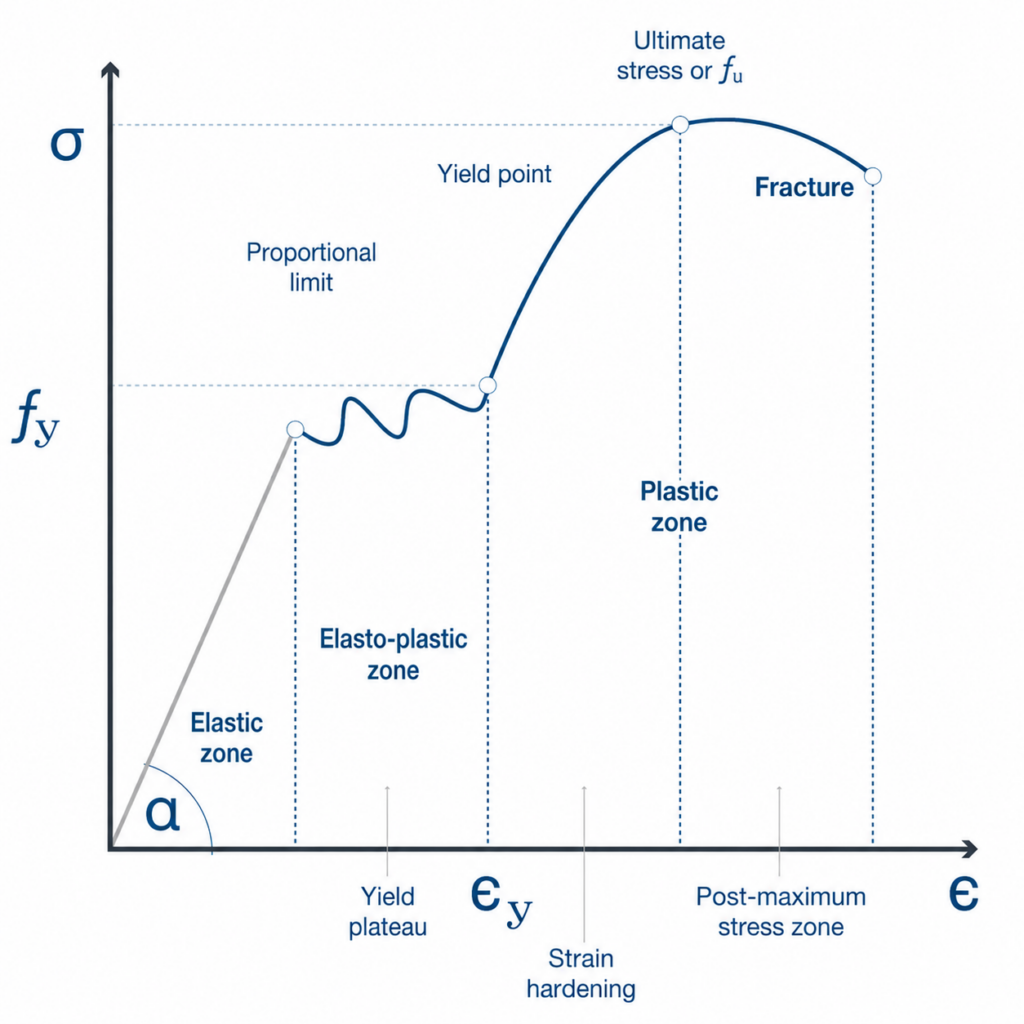
A simple way to understand Fy is to think of a rubber band. When you stretch it, it can return to its original shape. But if you pull it too far, it reaches a point where it no longer returns the same way and becomes permanently deformed. In steel, that point is known as the yield point or yield strength.
Fy stands for yield strength. It is the point at which steel begins to deform permanently.
Fu stands for ultimate tensile strength. It refers to the maximum load the material can withstand before failure.
Gr stands for Grade and is part of the designation of an ASTM standard. For example, in A572 Gr 50, “Gr 50” indicates the material grade within that specification.
In many cases, Gr 50 is associated with a minimum Fy of around 50 ksi, equivalent to approximately 345 MPa. Similarly, in A36 steel, the number 36 is related to an approximate minimum yield strength of 36 ksi, or 36,000 pounds per square inch.
However, “Gr” and “Fy” are not the same. The grade helps identify a classification within a specification, while Fy is a mechanical property of the material. In addition, not all products, thicknesses, or specifications behave the same way simply because they share the same grade number.
That is why the actual Fy must be confirmed through testing and the material documentation.
With these concepts clear, we can now review some of the most common ASTM grades according to the type of material, since not all steel products are specified in the same way.
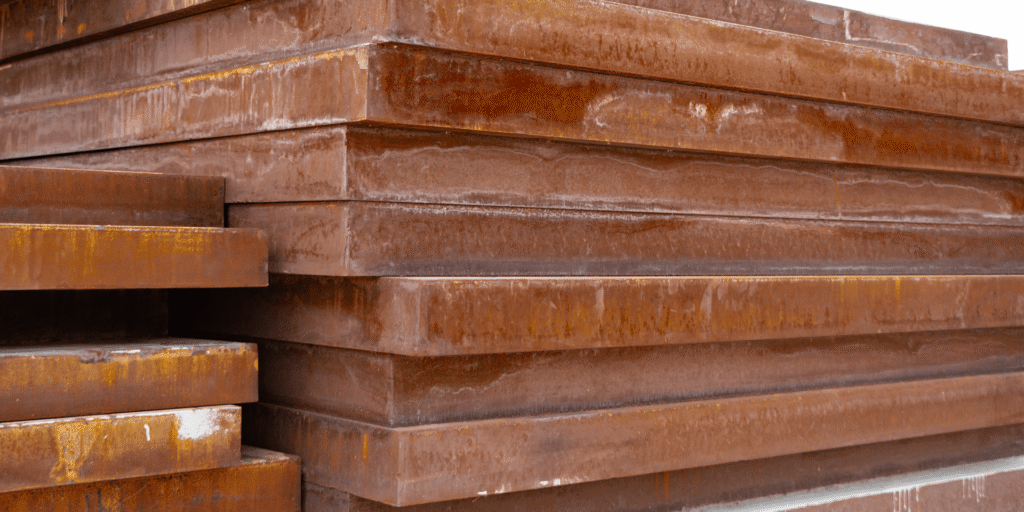
Plates: A36, A572 Gr 50, and A709 Gr 50
For steel plates, grade selection depends on the type of project, the required strength, and the material’s final application.
ASTM A36
It is commonly used for general structures, reinforcements, connections, and standard fabrication. Its main advantages are availability and cost.
ASTM A572 Gr 50
ASTM A572 Gr 50 plate is used when higher plate strength is required, without falling under bridge-specific specifications. This grade can help optimize sections, depending on the structural design.
ASTM A709 Gr 50
ASTM A709 Gr 50 plate is mainly associated with bridge or infrastructure projects where the specification calls for it. It should not be assumed to be interchangeable with A572 simply because both may share a similar yield strength.
Standard Steel Profiles: A36 or A572 Gr 50
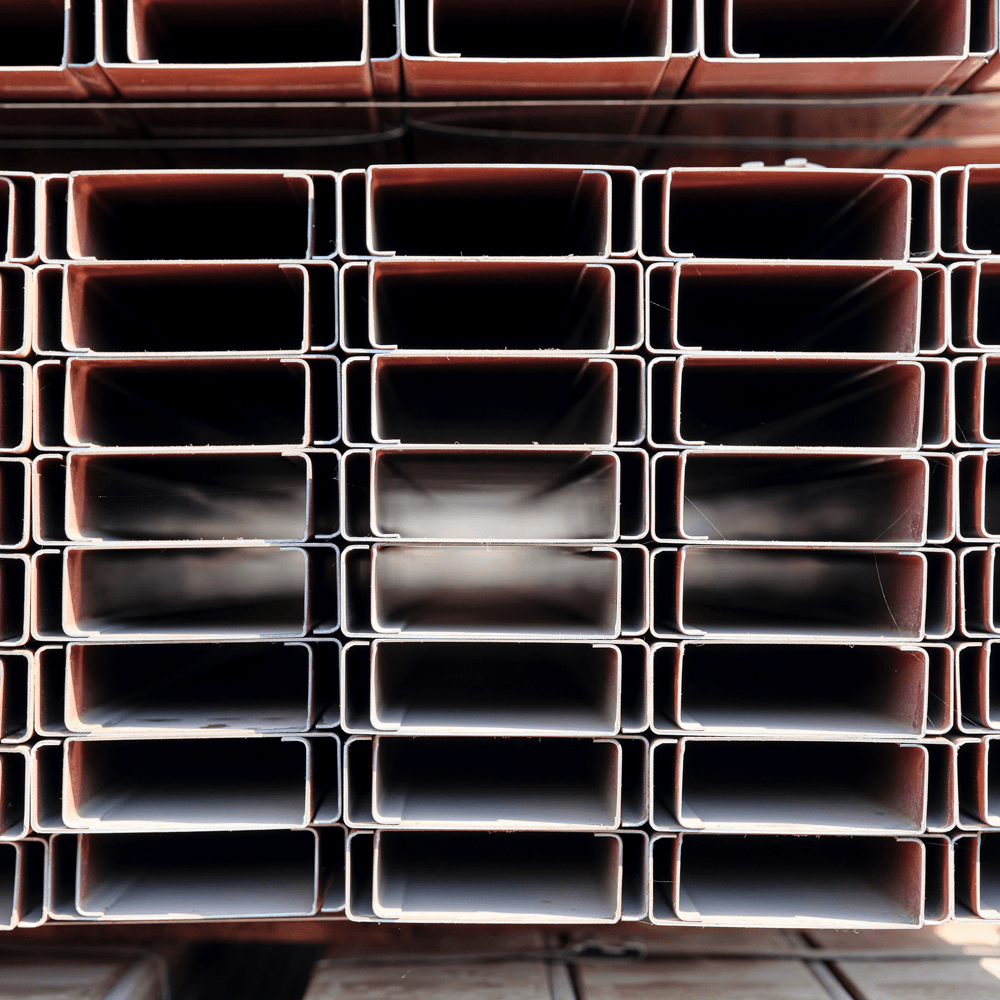
Standard profiles include products such as angles, channels, flat bars, round bars, square bars, and purlins, among others.
For these products, A36 is generally associated with general-purpose use, while grades such as A529 Gr 50 or A572 Gr 50 may be used when the project requires higher strength.
The selection depends on the structural role of the piece, material availability, and the engineering requirements.
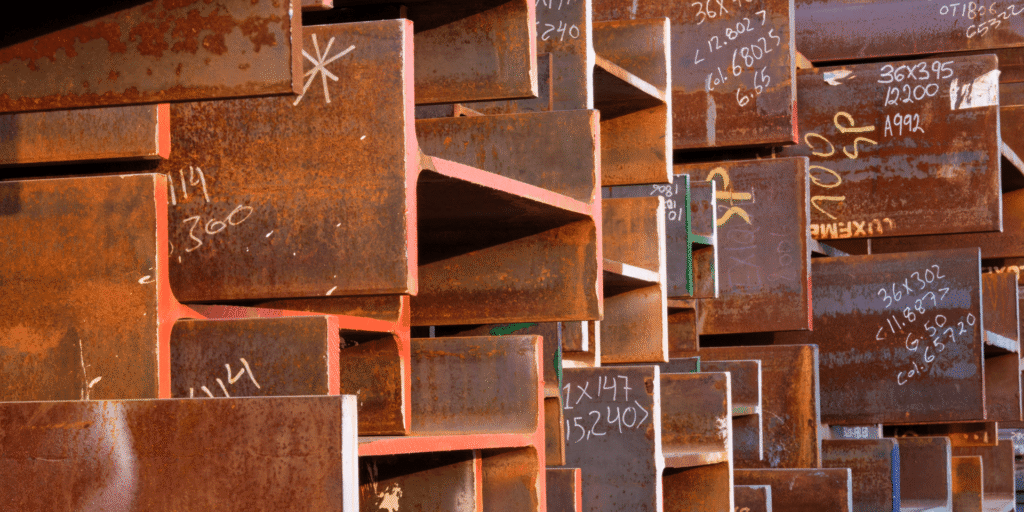
W / IPR Sections: A992 and A913 Gr 65/70
For W/IPR structural sections, it is common to find specifications such as ASTM A992 and, in more specialized cases, ASTM A913 Gr 65 or Gr 70.
ASTM A992
ASTM A992 steel is frequently used in W/IPR sections for structural construction. It is a typical grade for this type of section and must align with the project specification and the required structural profile.
ASTM A913 Gr 65 / Gr 70
ASTM A913 Gr 65 or Gr 70 steel is used when the engineering design requires a higher Fy in W/IPR sections.
Its advantage is that it provides higher strength within the same type of section, in accordance with the structural design. It is generally used in more specialized applications where higher mechanical properties are required.
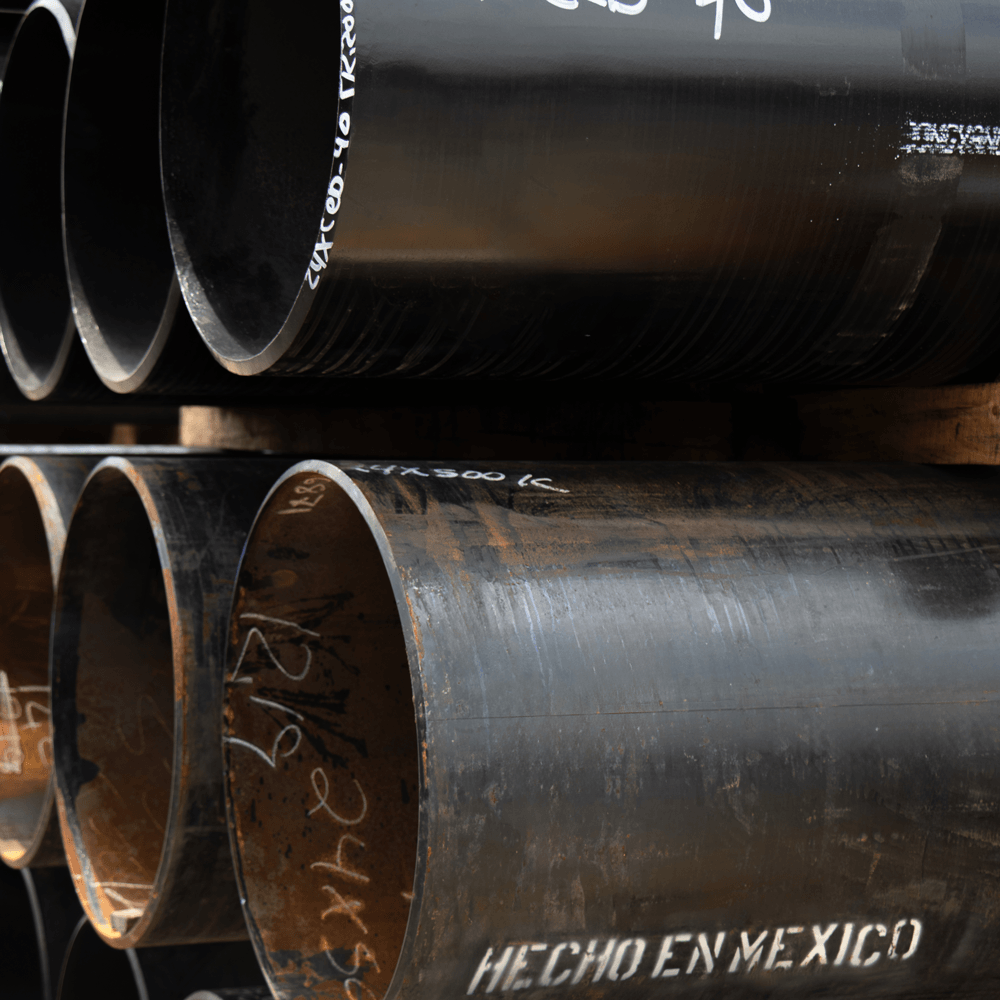
HSS and Round Pipe: A500 and A53
For tubular elements, it is important to distinguish the material specification, since not all round pipes or hollow structural sections are used for the same purpose.
ASTM A500
ASTM A500 is used for square, rectangular, and round HSS in structural applications. It is a common specification for tubular elements with a structural function and is often associated with columns, frames, diagonals, and other load-resisting members.
ASTM A53
ASTM A53 is used for round pipe, mainly in piping, conveyance, and general fabrication.
It is a widely known and commonly used specification in the market. However, it is more commonly associated with pipe and general-purpose applications than with primary structural HSS.
That is why, when requesting round pipe, it is important to confirm whether the project requires a structural element or pipe for general use.
Differences Between ASTM Steel Grades
Although some grades may seem similar, they do not always serve the same purpose.
A common mistake is assuming that all materials with a Gr 50 designation are equivalent. In reality, the grade must be analyzed within its full specification and in relation to the corresponding product.
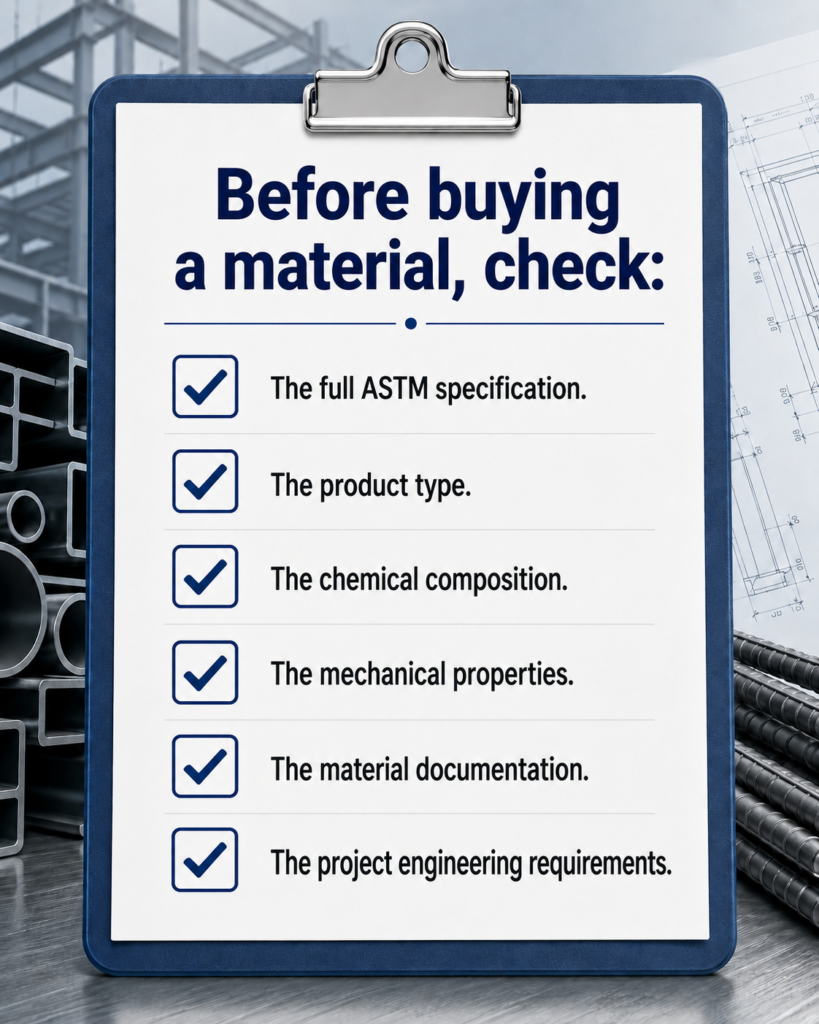
For example, a steel grade may share a similar minimum strength, but have a different chemical composition or additional requirements.
- • The full ASTM specification.
- • The product type.
- • Chemical composition.
- • Mechanical properties.
- • Material documentation.
- • Project engineering requirements.
This review helps prevent incorrect orders and ensures that the steel meets the expected performance requirements.
Conclusion
Defining the steel required for a project involves reviewing more than just dimensions or availability. The ASTM grade, product type, chemical composition, and mechanical properties are key factors in selecting the right material.
Understanding concepts such as yield strength, ultimate tensile strength, grade, and chemical composition helps support better purchasing decisions and avoid confusion between materials that may appear similar but are not necessarily equivalent.
That is why, before confirming an order, it is important to verify that the steel matches the project specification, its final application, and the material’s technical documentation.